NOTES FROM THE FIELD
Sharks of the shallows
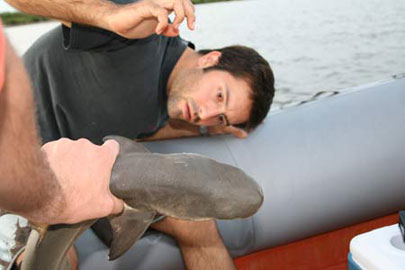
McGill’s Joseph DiBattista examines the umbillical scar on a young lemon shark
Amy Jefferies
By JOSEPH DIBATTISTA
Editor’s note: In an attempt to combat the brutal January cold, we’ve decided to run an installment of our popular Notes from the Field series that took place in sunny Florida last summer. If you’re a McGill researcher conducting field work and would like to file a Notes from the Field dispatch, or if you know of a great potential correspondent, contact Neale McDevitt at 514-398-1044 or at neale.mcdevitt@mcgill.ca.
June 23, 2007: We did it, we finally did it. After months of planning and shopping, and having secured both a vessel and able crew, we are set for our eight-day genetic sampling expedition to Marquesas Key (MK), Fla. MK is a mangrove-fringed island in the Florida Keys, approximately 25 km west of Key West. It encloses a shallow seagrass lagoon that also serves as a nursery ground for between 75 and 100 juvenile lemon sharks each year. This marks the ninth year that Dr. Samuel Gruber (a retired professor with the University of Miami and acting research director for the expedition) has returned to the area with his crew of capable volunteers in an attempt to characterize the mating patterns of lemon sharks. I have been coming back every year since 2004.
Looking over the gear, I am amazed by the sheer volume of it all: two trucks filled to capacity with research tools and personal items, a 19-foot Carolina skiff packed with mesh and iron rebar to build a shark holding pen, and a 17-foot inflatable Zodiac jammed with gillnets (to catch smaller sharks), fishing rods (to catch larger sharks), 80 gallons of fuel, and a spare 25hp boat engine. Although it is inevitable that we’ve forgotten something, no one could accuse us of not being prepared—we have spare items for our spare items.
We leave the Miami home of Dr. Gruber early in the morning, and make the four-hour drive south to Key West. As I climb in the 1987 Areostar—a vehicle lacking in air conditioning and functioning windows—I notice our driver has stripped down to his underwear to beat the unbearable Florida heat and humidity. It looks like it’s going to be one of those trips.
June 24, 2007: This morning we sailed west for MK aboard our 40-foot chartered vessel Off the Porch with a crew of nine and our two smaller research skiffs in tow. Upon arrival we set about marking the entry channel into the lagoon with reflective floats and cannonball weights (for navigation at night), and building the pen where sharks would be held for the remainder of the week. Once finished, we divide into crews and prepare the gear for our first night of fishing. Although logistically a bit more taxing, night is the best time to catch juvenile sharks because they are more active and less likely to spot and avoid the monofilament gillnets. One crew will fish for smaller sharks from 6 pm to 6 am and, while they sleep, the day crew will clean gear, prepare meals, and fish for larger (subadult) sharks on the flats surrounding the lagoon. With space enough for only five to sleep at a time, quarters are cramped. By the end of the week no one seems to mind, or at least they are too exhausted to complain.
We leave the main vessel at 5:30 p.m. One boat sets the net and checks it every 15 minutes; the other boat anchors near the holding pen in preparation for tagging. The waiting game begins. The stillness is incredible. Free of ambient city lights, stars pepper the sky. Every so often a satellite careens across the brilliant landscape. Almost six hours later the radio springs to life, “Tagging boat, tagging boat, come back to net boat.” We got one! The net boat drops off the shark; it is clearly a newborn, as evidenced by the open umbilical scar on its ventral side. Our crew goes about measuring the shark, inserting a passive integrated transponder (PIT) tag for mark-recapture purposes, checking for signs of infection or capture stress, taking a small piece of fin tissue for later genetic analysis, and finally weighing the animal before placing it in the holding pen. Unfortunately this is the only shark we caught tonight—disappointing given that we generally catch between 10 and 15 on the first night.
June 25-27, 2007: More fishing, more fishing, more fishing. No sharks, no sharks, no sharks. Where have they all gone? We catch only seven more juveniles over this period.
June 28, 2007: Tonight we decide to set our nets in a different location. En route to the predetermined spot, we notice smoke billowing out of the mangrove trees. We sail a bit closer to shore and spot a large group of people waving white towels, asking for help— Cuban refugees whose raft has run aground. We notify the Coast Guard who promptly arrive and bring them to safety. We are relieved to hear that the Cubans will be brought to Miami, debriefed and allowed to stay under refugee status. It is hard to focus on research after this experience, but we forge ahead. We catch and tag two more sharks.
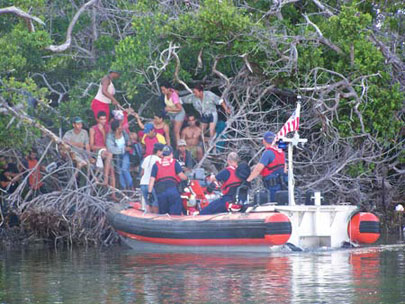
The U.S. Coast Guard rescues 19 Cuban refugees whose raft had run aground
Amy Jefferies
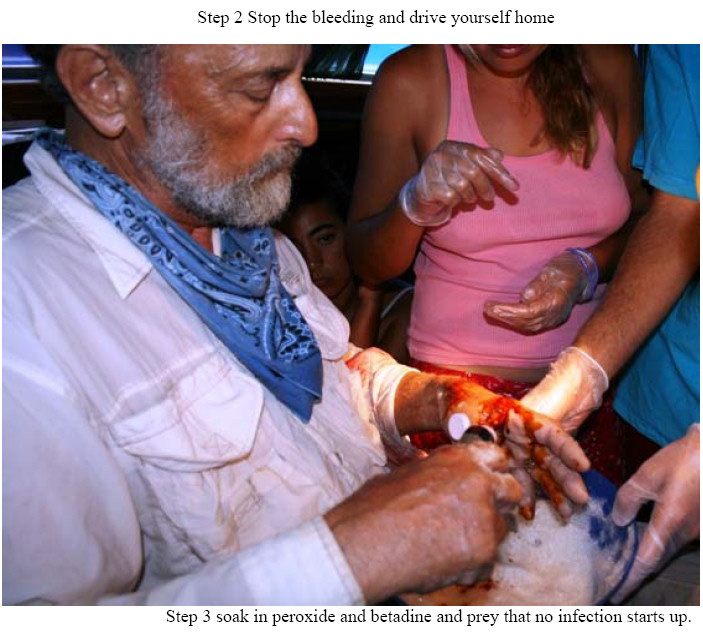
June 30, 2007: I am awoken by panic-stricken screams. “Doc has been bit, Doc has been bit.” Dr. Gruber has been bitten badly on the hand by a subadult lemon shark while trying to free the hook from its mouth. It is only the second time in his 40-year research career that he has been bitten, a formidable track record. It takes nearly two minutes to free his hand from the shark’s jaws using a boat paddle as a pry bar. The razor sharp teeth had cut him to the bone. Luckily, Dr. Gruber kept his composure during the ordeal and remained very still, as any sudden movements would have resulted in his hand being ripped to shreds.
I notice him sitting on the bench in the galley, clearly in pain now with his left hand immersed in a large bowl of hydrogen peroxide. The decision was promptly made that the trip would end one day early and Dr. Gruber would be brought to Key West hospital to receive medical attention—a change of plans to which he only begrudgingly agreed.

Dr. Samuel Gruber after being bitten by a subadult lemon shark
Amy Jefferies
July 1, 2007: Dr. Gruber gets stitches but his hand will be OK—he’ll be left with just a few puncture scars to mark the ordeal. After arriving back in Miami and unloading our gear we reflect on the research trip during which we only caught 17 lemon sharks. Our lowest catch from previous years was 34. The most likely explanation for the low number was that our timing was off. We had arrived almost a month earlier than previous years to avoid hurricanes, which have hampered our work in the past. But it looks like we preceded the arrival of most pregnant females entering the nursery lagoon to give birth. We are not discouraged by the fruits of our labour. Each sample we obtained is critical, and will help answer key questions about the mating system of this species.
Joseph DiBattista is a PhD candidate in the Department of Biology under the supervision of Dr Andrew Hendry. He is part of a collaborative research project on mating systems and evolution of lemon shark populations in the Atlantic involving McGill University, the Field Museum in Chicago (www.fieldmuseum.org), and the Bimini Biological Field Station in the Bahamas (www.miami.edu/sharklab). This project is partly funded by the Natural Sciences and Engineering Research Council of Canada, and the National Science Foundation, among others.